
.svg)





.avif)

For three decades, InterAction has been one of the most popular CRM for large law firms. With LexisNexis moving their product line to the cloud through InterAction+ AI, launched in commercial preview in March 2026, many firms are treating their next contract renewal as a moment to review alternatives. This guide covers the six best LexisNexis InterAction alternatives for law firms in 2026, with a clear view of what each one does well, how long it takes to implement, and the firm size it suits best.
1. Nexl
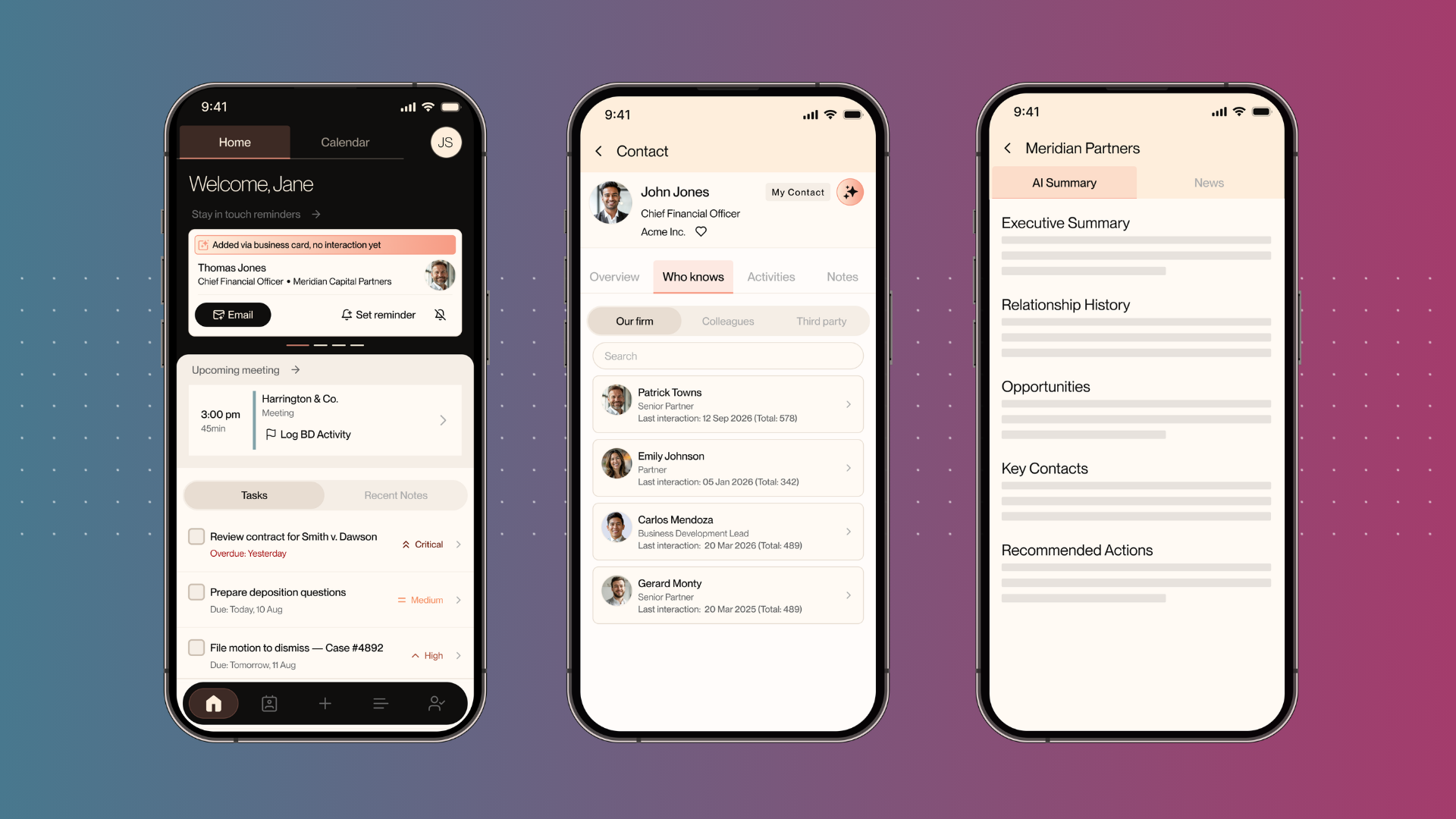
Nexl is a growth system built for law firms by former lawyers and legal professionals. It brings CRM, relationship intelligence, email marketing, event management, and collaborative workspaces together in one cloud-native platform. Its zero-data-entry CRM captures interactions automatically from email and calendar, without recording privileged content, so relationship records stay current without any input from fee earners. The "who knows who" mapping shows connections across the firm, surfacing cross-sell and referral opportunities from relationship data. Nexl is also ISO/IEC 27001:2022 certified.
Implementation timeline: Weeks, run in-house so firms have one point of accountability.
Typical firm size: Mid-sized firms of 100 to 500 attorneys through AmLaw 200, Magic Circle, and global firms.
2. Intapp DealCloud
Intapp DealCloud began in capital markets and has expanded into the legal market. Its strengths are pipeline management, deal tracking, and third-party data enrichment from providers like PitchBook and FactSet, which makes it a strong fit for transaction-heavy practices. The platform sits inside the wider Intapp ecosystem, so firms already using Intapp for conflicts or compliance gain a unified data layer. Implementation usually involves Intapp's professional services team, and users note a learning curve and significant configuration to align the system with legal workflows.
Implementation timeline: Months.
Typical firm size: Large, transaction-driven firms.
3. Foundation 365
Foundation 365 is Litera's AI-powered legal CRM, built on Microsoft Dynamics 365. It combines CRM, matter management, document management, and work management for large firms, with deep integration across Outlook, Teams, SharePoint, and Power BI. For firms already using Microsoft 365, the native integration is appealing. However, the trade-off is the configuration and administration that a Dynamics deployment requires.
Implementation timeline: Months.
Typical firm size: Large and global firms invested in Microsoft 365.
4. Introhive
Introhive is one of the most established relationship intelligence platforms in the legal market. Its strength is data automation: cleaning, enriching, and maintaining contact records, then mapping relationship strength across the firm. Many large firms run Introhive alongside an existing CRM to keep data current. Because it focuses on the intelligence layer, Introhive works as a complement to a system of record instead of replacing one, so firms still need a CRM underneath it.
Implementation timeline: Weeks to months, depending on data sources.
Typical firm size: Large firms with an existing CRM to enrich.
5. Salesforce
Salesforce is the world's most widely adopted CRM and the reference point for sales pipelines, automation, and customer data in almost every sector. Where it excels is structured selling, built around clear deal stages, a dedicated sales function, and disciplined record-keeping. That model maps neatly onto software vendors and financial services companies. Law firm growth, however, tends to run on personal relationships, referrals, and partner networks, so shaping Salesforce around legal business development calls for heavy customization and, in most cases, a consulting partner to deliver it. The firms that get the most from it are alternative legal services providers that run like conventional B2B operations, and practices sitting within a larger corporate group that already standardizes on Salesforce.
Implementation timeline: Months, usually with a consulting partner.
Typical firm size: Alternative legal services providers, and practices within a larger corporate group already using Salesforce.
6. Microsoft Dynamics 365
Microsoft Dynamics 365 is a common starting point for firms already invested in Microsoft 365. It has contact management, pipeline tracking, workflow automation, and reporting through Power BI, with the Power Platform on hand when a firm wants to build low-code, custom apps. What it lacks out of the box is similar to Salesforce: legal workflows. Mapping it to legal BD processes requires add-ons like Dynamics 365 Sales for relationship intelligence and Dynamics 365 Customer Insights for email marketing, each licensed and priced separately. Turning the platform into something that fits legal business development almost always takes a specialist consulting partner to build and maintain.
Implementation timeline: Months, usually with a specialist consulting partner.
Typical firm size: Firms already invested in Microsoft 365 with IT support
How to choose the right InterAction alternative
The right choice depends on how your firm grows and what it already runs. Firms that grow through partner relationships, referrals, and cross-selling will get the most from a legal CRM with automatic data capture and firm-wide relationship mapping like Nexl. Firms deep in transaction work may value Intapp DealCloud's deal and data tooling. Whichever way you lean, adoption is the factor that decides whether the investment pays off, so weight ease of use for lawyers heavily in your decision.
Ready to see how Nexl works? Book a demo.
Ready to transform your firm's growth?
%20(1).avif)
%20(1)%20(1).png)
.png)
.svg)

%20(1).avif)