
.svg)





.avif)

For years, InterAction has been the default CRM at large law firms, used by roughly three quarters of the Am Law 100 and a similar share of the largest firms globally. In March 2026, LexisNexis announced the commercial preview of InterAction+ AI, a cloud-native rebuild of the platform with its Protégé AI assistant embedded. For firms still running the legacy on-premises version, upgrading to the new platform will require a platform migration, making this a good time to consider other options if your InterAction contract is coming up for renewal.
This guide explains why firms are reviewing InterAction now, what to look for in a replacement, and how a migration works.
Why law firms are looking at InterAction alternatives now
The relaunch of InterAction as a cloud AI platform means legacy customers face a migration regardless, so the renewal window is a natural point to compare alternatives.
InterAction launched in 1993 and was acquired by LexisNexis in 2004. It built its position on deep contact management and integration with LexisNexis research content. Much of that install base still runs the on-premises version, which depends on lawyers updating records by hand and requires dedicated IT resources and a full-time CRM administrator to maintain.
The March 2026 commercial preview of InterAction+ AI signals a shift to cloud across their product line. A commercial preview is an early release, so firms adopting it now are moving onto a platform that is still maturing. For a firm whose contract is coming up, the two options are migrating onto a newer version of the same system or evaluating a law firm-specific system that was built for the cloud from the start.
Is InterAction reaching end of life?
LexisNexis has not published a formal end-of-life date for legacy InterAction, though the launch of InterAction+ AI as the next-generation platform points to where ongoing investment is heading.
There is no public sunset date today but firms using the legacy on-premises product should plan for a move on their own timeline instead of waiting for one to be forced on them. Treating an upcoming contract renewal as your planning trigger keeps means the decision is in your hands.
What to look for in an InterAction CRM replacement
The top priorities in an InterAction CRM replacement are lawyer adoption, breadth of features, cloud-native architecture, implementation speed, and security certification.
The reason most legal CRM projects disappoint is low adoption. Around 70% of CRM implementations fail to deliver their intended value. In law firms the usual cause is manual data entry that lawyers deprioritize. Any replacement you consider should reduce that burden, ideally to zero.
Beyond adoption, look at how much functionality the platform has. A system that combines CRM, relationship intelligence, email marketing, and event management in one place removes the integration overhead of stitching several tools together. Check the deployment model and implementation timeline, since these decide how quickly your team sees value, and confirm the vendor's security posture too.
Nexl vs InterAction at a glance
How Nexl compares to InterAction
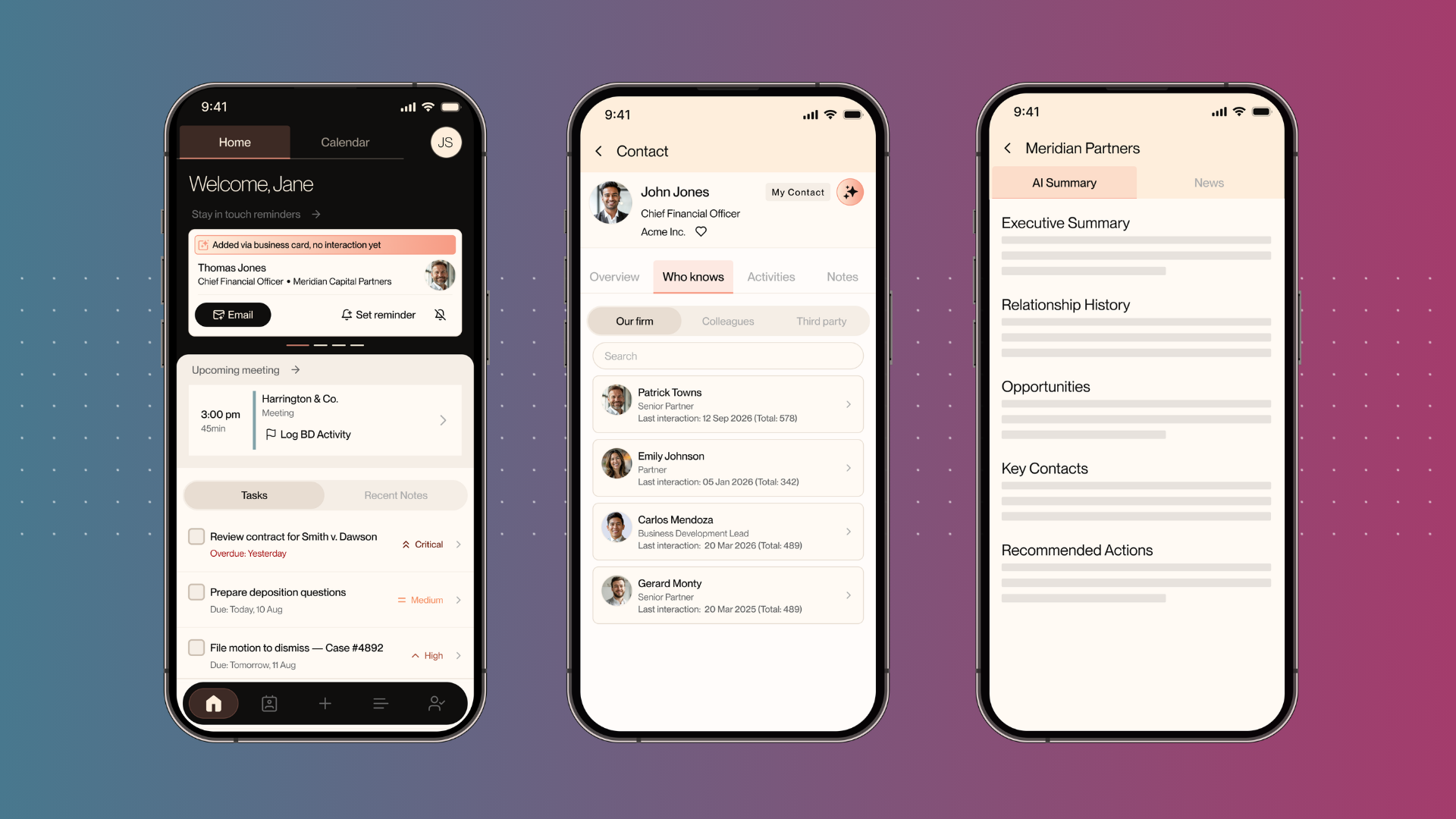
Nexl is the growth system for law firms that brings CRM, workspaces, marketing, and relationship intelligence together in one place. It was built by former lawyers and legal professionals as a cloud-native platform.
Nexl's zero-data-entry CRM captures interactions automatically from email and calendar systems, without recording privileged information, so relationship records stay current with no input from fee earners. The "who knows who" mapping then shows connections across the whole firm, which surfaces cross-sell and referral opportunities from real relationship data.
Nexl also includes built-in email marketing with drag-and-drop builders and campaign analytics, event management with RSVP tracking, and collaborative workspaces for business development planning. Firms running InterAction usually have to add third-party tools for these functions, which increases both cost and complexity across the technology stack.
Additionally, Nexl runs implementation in-house and deploys in weeks, giving firms one point of accountability. Legacy InterAction deployments are measured in months and lean on dedicated IT support and a full-time administrator.
How to migrate from InterAction
Migrating from InterAction requires auditing your data, mapping relationships, running a phased cutover, and leaning on in-house implementation support.
A migration is more manageable than most firms expect when it follows a clear sequence:
- Start by auditing what is in your current system, so you carry across clean contact and leave duplicates/dormant records behind.
- Next, map the relationships that matter most, meaning the clients, referrers, and prospects your growth depends on, so the new system reflects how the firm operates.
- Then, agree on a phased cutover with your provider and run the two systems in parallel for a short period, so nothing is lost in the handover.
For firms coming off the on-premises version of InterAction, the automatic capture in Nexl solves the data quality problem that dogged the old system. Records stay current on their own once the migration is complete, so the firm doesn't have to chase lawyers for updates.
Which firms should consider switching
InterAction still suits Am Law 100 firms that are deeply embedded in the LexisNexis research ecosystem, have dedicated CRM administration teams, or want to stay with a single vendor for both content and CRM.
Nexl is the stronger fit for mid-sized law firms of 100 to 500 attorneys, along with AmLaw 200, Magic Circle, and global firms, that want high adoption from lawyers, fast deployment, and a single platform covering CRM, relationship intelligence, marketing, and collaboration. Firms in this group tend to grow through relationships and cross-selling, and Nexl is designed around that model of growth.
Ready to see how a migration would work for your firm? Book a demo now.
Ready to transform your firm's growth?
%20(1).avif)
%20(1)%20(1).png)
.png)
.svg)

%20(1).avif)