
.svg)





.avif)

Every law firm already has thousands of valuable relationships. The problem is that no one has a clear picture of who knows whom. A client opportunity comes in, the team prepares a pitch, and only afterwards does someone realize that three other partners already had strong relationships with that company's general counsel. The pitch goes ahead without them and... it fails. The opportunity was there, but the visibility wasn't.
This happens more often than most firms realize. A partner closes a major matter. Six months later, the client needs a service owned by another practice group and the opportunity goes nowhere because there is no system to flag it. An associate meets a referral source at a conference and thinks of a partner who should connect with them. The introduction never happens because there is no way to link that signal to action. Relationship intelligence helps solve that by making those connections visible and actionable.
What is relationship intelligence?
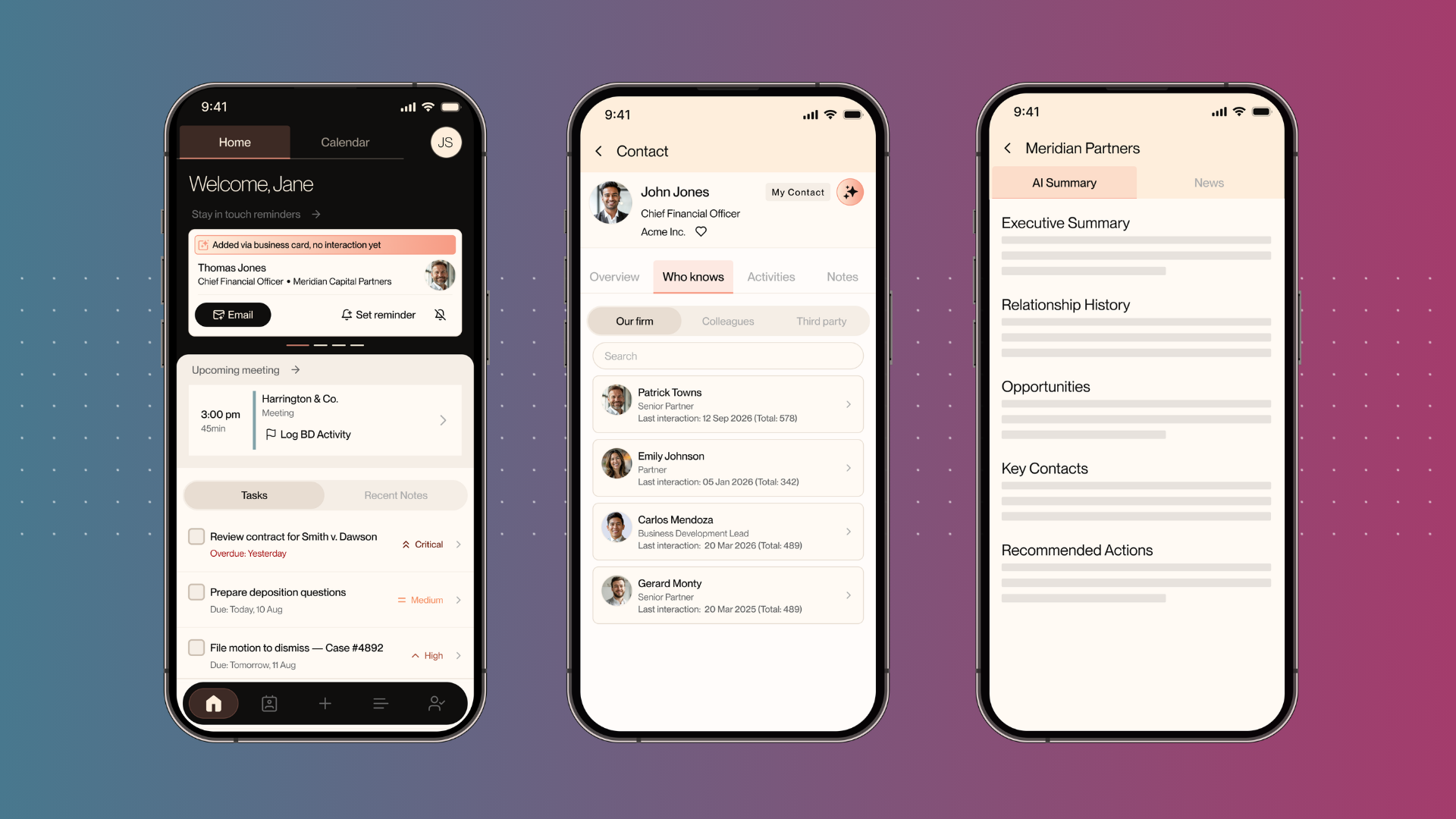
Relationship intelligence is the ability to capture, map, and act on the full network of connections across your firm. It helps answer questions your team asks regularly: who at our firm knows this company's CFO, which clients is this partner most active with, and who should be part of this pitch?
This is different to a standard CRM. A CRM records transactions, showing that you closed a matter, who was involved, and what it was worth. Relationship intelligence captures the network of connections, engagement patterns, and growth signals that sit behind those transactions.
The data already exists inside your firm. It lives in email headers, calendar invites, and communication patterns. A relationship intelligence platform pulls that data together, organizes it, and makes it useful.
You may also see this described as relationship intelligence software, client intelligence, or enterprise relationship management. These labels overlap, and all point to the same goal of making your firm's relationships visible and useful across every practice group.
Why CRM alone is not enough
A CRM is essential. It keeps matters organized, contacts clean, and history searchable. Where many CRM implementations fall short is that lawyers don't consistently update contact records. They send emails, accept calendar invites, and take calls, but CRM data becomes stale when it relies on manual input. Relationship intelligence stays current because it reflects what’s happening in the tools lawyers already use.
A partner sends an email to a client contact; a lawyer accepts a meeting with a prospect. These are engagement signals. These moments happen across the firm all day and together they create a far more accurate view of relationship strength.
The two systems work best together. A CRM provides structure and context, while relationship intelligence provides visibility and accuracy. A CRM may tell you that a client is a $500K annual relationship. Relationship intelligence can show that the same client is active with five partners, that the CFO is the strongest relationship, and that a likely restructuring need is emerging.
The four pillars of relationship intelligence
How relationship intelligence works in practice
A partner at a mid-size firm is preparing a pitch for a new client in the financial services sector. Without relationship intelligence, they would ask around informally, check a few emails, and walk into the pitch with an incomplete picture of who else in the firm knew this prospect.
With relationship intelligence, the picture can be assembled immediately. Three other partners have existing relationships with the company's CFO and GC. One of them worked on a matter for a related entity two years ago. The pitch becomes a coordinated effort across practice groups, with the right people in the room.
The same logic applies to retention. A client's engagement score starts to drop. Fewer emails, fewer matter openings, a key contact who hasn't been reached out to in 90 days. Relationship intelligence surfaces this before anyone notices the relationship has gone quiet, giving the right partner the chance to reach out before the client makes a decision.
Relationship intelligence vs CRM: a comparison
The best type of platform for law firms is a legal CRM with relationship intelligence features built in.
What to look for in a relationship intelligence tool
Relationship intelligence software for law firms varies widely in how it captures and surfaces data. The features that matter most for law firms are automatic data capture from email and calendar, privacy-safe header-only processing so message content is never stored, firm-wide visibility rather than per-user silos, relationship strength scoring, and mobile access for lawyers who are rarely at their desks.
The system should also integrate cleanly with your existing CRM so that relationship data enriches your existing records rather than creating a parallel database that needs separate maintenance.
Ready to transform your firm's growth?
%20(1).avif)
%20(1).png)
%20(1)%20(1).png)
.svg)

%20(1).avif)