
.svg)





.avif)

Acquiring a new client costs between 5 and 25 times more than retaining an existing one. For a law firm, that stat represents several time-consuming processes: new client pitches, competitive tenders, introductory work priced to win, and months of relationship building before a second matter appears.
Most firms understand this in principle, but few build the systems that make retention a managed outcome rather than an accidental one. This isn’t a niche problem—72% of firms don't measure client churn at all, meaning most firms are operating without visibility into which client relationships are at risk.
Why law firms lose clients
Poor legal work is rarely the reason. Clients leave because they feel forgotten, received no proactive communication between matters, or because their key relationship was with a partner who left the firm.
The pattern is consistent: your relationship was strong once, but nothing was in place to maintain it. There were no prompts to follow up, no visibility into whether the client was still engaged, and no early warning when the relationship started to cool.
A client who hasn't heard from their firm in six months isn't necessarily lost, but they are vulnerable, and the firm has no way of knowing it.
The link between relationship data and retention
Firms that have visibility into client engagement, including how often clients are contacted and relationship strength, retain more clients. Firms with systematic BD processes average more than double the services per client compared to the most rainmaker-dependent firms.
The firms that retain clients consistently have systems that keep relationships visible, prompt the right outreach at the right time, and flag when something is starting to slip. The five strategies below are the building blocks of creating that kind of program at your firm.
Strategy 1: Systematic stay-in-touch
The most common retention failure is a relationship that goes quiet without anyone noticing. The work was good, the client was satisfied, but somewhere between matters the contact faded and no one caught it in time. Firms with active pipeline management see client churn of 6.6%, compared to 7.5% at firms without it. Only 6-10% of firms operate with a systematic BD culture, and for those that do, the difference in outcomes is significant.
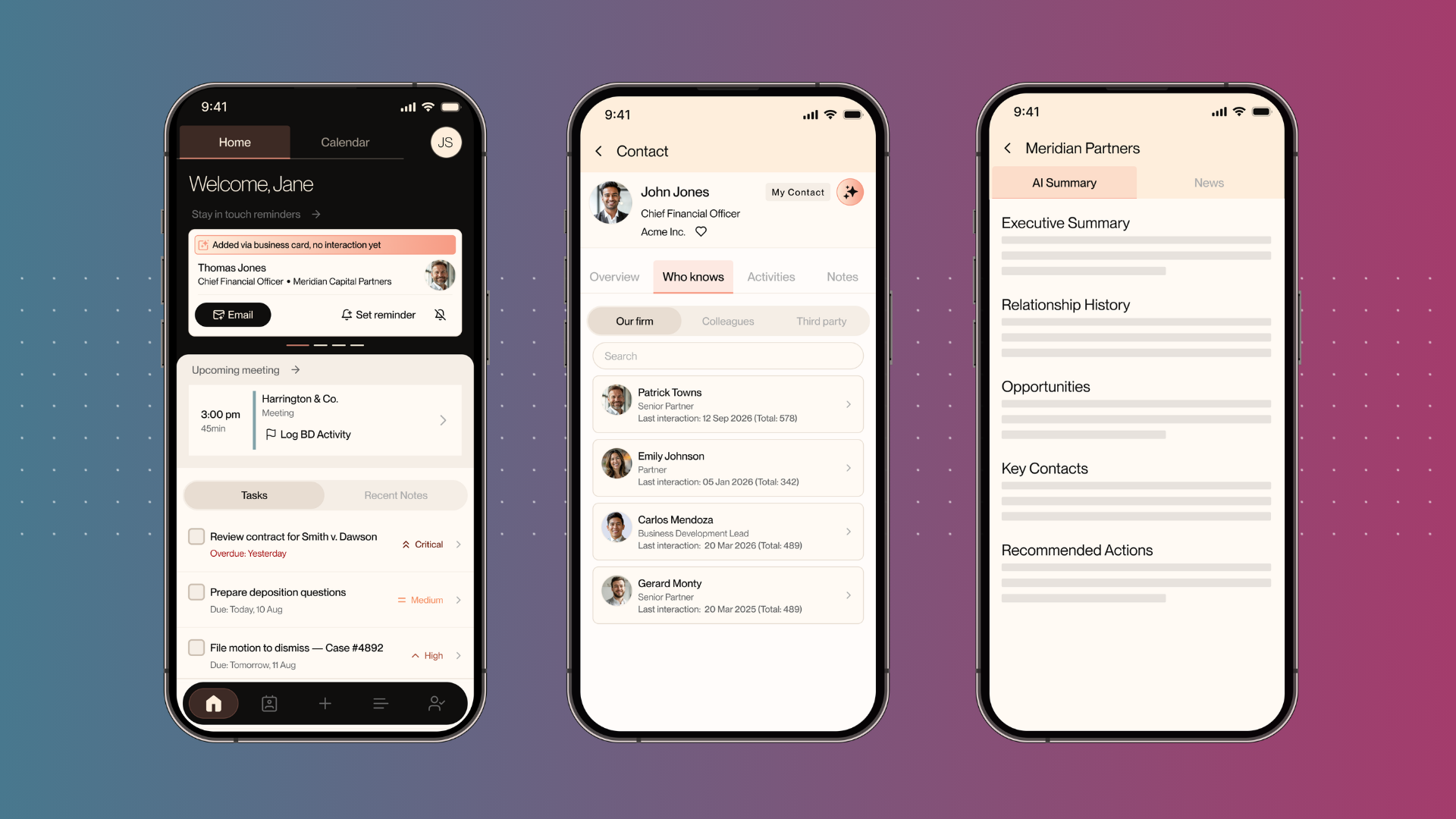
Fixing this requires a systematic approach rather than a manual one. Automated stay-in-touch reminders, tied to relationship data, surface the right prompt at the right time. When a key client contact hasn't been reached in 60 days, the relevant partner gets a notification, without a spreadsheet in sight.
Strategy 2: Proactive value delivery
Most client communication is reactive. A matter opens, work is done, the matter closes. In between, silence. Proactive value delivery means reaching out before the client has a reason to call, by sending a relevant regulatory update, flagging a risk emerging in their sector, or sharing insight from a related matter. The goal is to stay visible and useful between matters, so the relationship doesn't reset every time a new one opens.
Strategy 3: Client feedback loops
Regular structured feedback is one of the highest-return retention activities a firm can run. A client who raises a concern and sees the firm respond to it becomes more loyal as a result. Asking and responding in a visible way demonstrates that the firm values the relationship beyond the matter. Keep surveys short, act on the results openly, and feed what you learn back into how you serve that client going forward.
Strategy 4: Identifying at-risk clients before they leave
The warning signs are usually there. Declining engagement, fewer emails, no new matter openings, a key contact who hasn't responded in weeks. Without a system to surface these signals, no one sees them until it's too late. Relationship intelligence changes that by tracking engagement automatically and flagging relationships that are cooling.
Strategy 5: Cross-selling as a retention tool
Clients who use multiple practice areas are far less likely to leave. The economics are straightforward: the more embedded a firm is in a client's operations, the higher the switching cost and the stronger the relationship. Cross-selling done well is about identifying where the client has a need the firm can serve and making the right introduction at the right moment.
Measuring retention: the metrics that matter
For retention, five metrics will give you the clearest picture:
- Client retention rate year on year tells you whether you're holding your base
- Repeat matter rate shows how often clients come back
- Share of wallet by client reveals how embedded you are in their business
- Matter satisfaction score captures how clients feel about the work while it's still fresh
- Engagement score, drawn from your relationship data, flags which relationships are active and which are starting to cool.
Ready to transform your firm's growth?
%20(1).avif)
%20(1).png)
%20(1)%20(1).png)
.svg)

%20(1).avif)