
.svg)





.avif)

Choosing the right CRM is one of the most consequential technology decisions a law firm can make. Research shows that 70% of CRM implementations fail, and that figure has barely moved in a decade. The problem is rarely the software itself. Most implementation failures come down to a mismatch between how a CRM is designed to work and how law firms grow their books of business.
Law firm growth rarely follows a simple sales funnel. New opportunities come from a broad range of sources, like partner introductions, existing client relationships, referrals, events, sector campaigns, or conversations that started months earlier. The best CRM for a law firm is one that supports this workflow. For most commercial and corporate firms, whether mid-sized practices of 100–500 attorneys or larger AmLaw 200 and global firms, that means you need a platform built around relationships, referrals, partner networks, and cross-practice collaboration.
This guide covers how to choose a CRM for a law firm, what to look for in legal CRM software, and how Nexl compares to the major platforms commonly considered by law firms.
Table of contents
- How law firms grow
- What a legal CRM needs to do
- The types of CRM law firms consider
- Questions to ask when evaluating a legal CRM
- Red flags to watch for
- How to build the internal business case
- Comparison table of common legal CRMs
- Key takeaways and an implementation checklist
- Frequently asked questions
How law firms grow
The short answer: Law firm growth is relationship-led. A legal CRM reflects that by capturing connections automatically and giving the whole firm visibility into who knows who.
In many industries, CRM systems are built around sales teams, lead scoring, pipeline stages, and individual activity. That model works well when prospects move through a defined funnel, but most law firms work differently.
Growth at most firms relies on relationships. Partners develop trust with clients over time, lawyers identify opportunities through active matters, and BD and marketing teams build pipeline through campaigns, events, and client programs. Across all of it, firm leadership needs visibility into what's happening at the client, sector, and practice group level.
A CRM for law firms needs to go beyond contact storage, giving the firm visibility into who knows who, which relationships are active, where follow-up is needed, and what growth opportunities exist. What that looks like in practice differs from firm to firm. The most useful distinction is between firms that grow primarily through high-volume intake and those that grow through long-term relationship development.
Intake-led firms
Some firms need CRM software to manage high-volume inquiries. These firms often have consumer-facing practices such as family law, personal injury, immigration, or smaller business advisory work. The CRM focus for these firms is usually intake, matter conversion, automated follow-up, and lead management. A system built for this helps firms capture inquiries, qualify potential clients, and move them toward an initial consultation or engagement.
Relationship-led firms
Larger commercial, corporate, and full-service firms, including mid-sized firms of 100-500 attorneys and AmLaw 200 or Magic Circle practices, usually have a different growth model. Their opportunities tend to come from existing client relationships, referral networks, partner introductions, and cross-practice collaboration.
For these firms, the CRM needs to support long-term relationship management. It should help the firm understand client engagement, map relationships, coordinate activity across the firm, and identify where it can add more value to existing clients. This is where a CRM built specifically for law firms is most useful.
What a legal CRM needs to do
The short answer: The best legal CRM captures relationship data automatically, surfaces connections across the firm, and connects marketing and BD activity in one place, so lawyers can contribute to growth without changing how they work.
The right legal CRM gives lawyers, BD teams, and firm leaders a shared view of the firm's relationships, reducing manual work, improving visibility, and making it easier to act on growth opportunities. This comes down to a handful of core capabilities that you should look out for when evaluating your options. A CRM that supports how law firms grow should be able to:
- Capture relationship activity automatically
- Surface the connections that exist across the firm
- Connect marketing and CRM data in one place
- Support event planning and follow-up
- Give partners and BD teams a practical way to track pipeline
Capture interactions automatically
A CRM that relies on lawyers manually logging every meeting, email, or phone call won't be adopted. Lawyers are busy, and adding administrative tasks to their day is one of the most reliable ways to ensure a system goes unused.
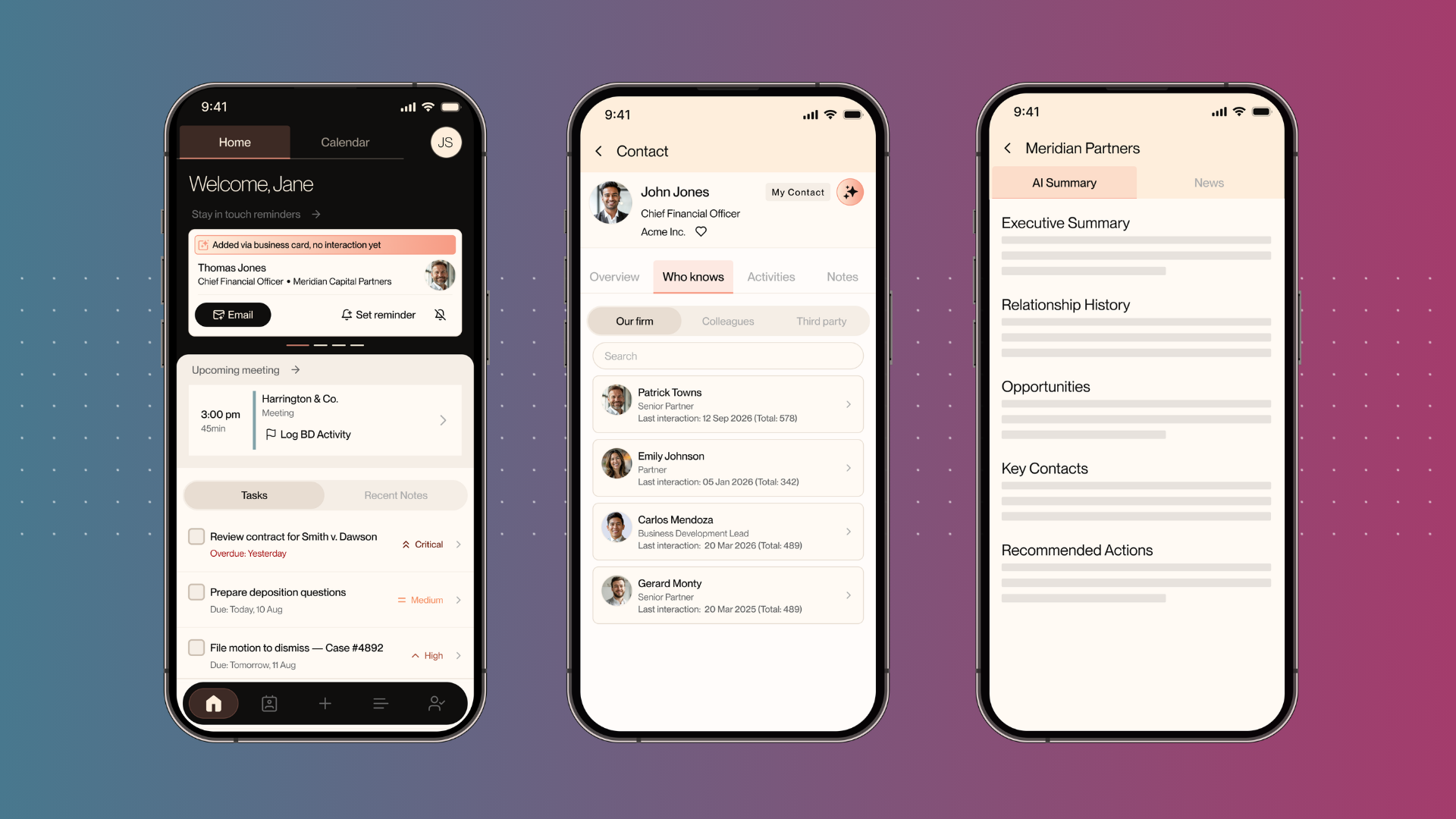
A zero-data-entry CRM for lawyers captures relationship activity from the systems lawyers already use, like Microsoft Outlook, giving the firm a more accurate view of client engagement without asking lawyers to change how they work. Automatic capture helps firms answer practical questions without additional admin, like who last spoke to specific clients, which partners have the strongest connection, whether the firm has been in touch recently, and which relationships are active or starting to go quiet.
"Instead of us asking attorneys who their key contacts are, Nexl can tell us. It's offered a whole new level of interaction with attorneys where we can provide informed data versus relying on them for information." — Tanya Riggan, Director of Client Relations, Koley Jessen
Surface connections across the firm
Relationship intelligence is one of the most valuable features a legal CRM can offer. Law firms tend to have far more relationship capital than they can see. Partners, lawyers, and BD professionals each hold pieces of the puzzle, but without a system to bring those connections together, the firm is working with an incomplete view of who it knows and how well.
A law firm CRM with relationship intelligence built in surfaces those connections, showing who has the strongest relationship with a client, prospect, referral source, or target contact. That visibility supports many practices across the business of law, including pitch strategy, client planning, lateral integration, and cross-practice collaboration.
Connect marketing and CRM data
Marketing activity is more effective when it draws on the same relationship data the rest of the firm uses. When email marketing, event management, and CRM operate as separate systems, the firm ends up with a fragmented view of its own client relationships. A well-integrated CRM gives marketing and BD teams a shared foundation, making it easier to segment audiences, plan campaigns, follow up after events, and report on engagement across the firm.
Support events and follow-up
Events are a significant part of law firm business development, but the return on them often depends less on the event itself than on the work that surrounds it. Firms that get the most from their events invest in preparation and structured follow-up, using their CRM to coordinate both. That means knowing who to invite and why, tracking who attends, and making sure the right conversations lead to the right next steps rather than getting lost in the week that follows.
Track pipeline and opportunities
Pipeline management in a law firm should help the firm track opportunities, proposals, referrals, cross-sell activity, and client growth plans. For relationship-led firms, opportunity tracking works best when it connects directly to relationship context. A potential matter is easier to progress when the firm can see the client history, key contacts, relationship owners, and recent engagement alongside the opportunity itself.
The types of CRM law firms consider
The short answer: The right category of CRM depends on your firm's growth model. A CRM designed for law firms is the strongest fit for relationship-led firms; enterprise CRMs and marketing platforms require significant adaptation before they serve legal BD well.
A law firm CRM comparison usually comes down to a handful of platform categories. Each can make sense in the right context, and the choice depends less on which platform is most capable in the abstract and more on which one fits the way your firm grows.
Purpose-built legal CRM
A CRM designed for law firms, like Nexl or ContactEase, is built around how legal businesses develop relationships and win work. These platforms tend to focus on relationship intelligence, automatic interaction capture, client engagement, pipeline visibility, events, and BD workflows, making them a natural fit for commercial, corporate, and full-service firms, from mid-sized practices to global firms, that want to improve relationship-led growth.
Horizontal enterprise CRM
Enterprise CRM platforms, like Salesforce or Microsoft Dynamics, are built for broad use across many industries. They can be powerful and highly configurable, but that flexibility comes with a cost: significant setup, ongoing administration, and internal ownership to keep them running well. For law firms, a horizontal enterprise CRM often needs considerable adaptation before it can support legal business development. This category tends to suit firms with large technology teams, complex enterprise requirements, and the budget to support ongoing configuration work.
Practice management platforms with CRM features
Practice management systems like Clio Grow are built to handle legal operations: matters, documents, time, billing, and client service workflows. Some include CRM or intake features, which can work well for firms that primarily need inquiry management or straightforward contact tracking. For relationship-led firms, these features tend to be too limited, built around matter operations rather than the kind of firmwide relationship visibility that drives client development.
Deal management platforms adapted for legal
Some firms, particularly those working across private equity, M&A, finance, or capital markets, consider deal management platforms like Intapp DealCloud as part of their CRM evaluation. These systems can be useful for tracking transactions, mandates, and deal flow, but are generally less suited to the broader relationship management needs of a full-service firm, where growth depends on firmwide connections rather than a single deal pipeline.
Marketing automation platforms used as CRMs
Marketing automation platforms like HubSpot can be strong for campaigns, email programs, landing pages, and inbound lead activity, making them a reasonable fit for firms with high-volume marketing programs or intake-led practices. For relationship-led firms, they tend to fall short on relationship intelligence, partner networks, and client development, usually requiring additional tools or custom processes to cover the gaps.
Questions to ask when evaluating a legal CRM
The short answer: The most important questions to ask a legal CRM vendor are about adoption, implementation timeline, data capture, and total cost of ownership. Firms that skip these questions tend to discover the gaps six months after go-live.
Choosing the right CRM for your firm takes more than a product demo and cost comparison. The questions below will help your firm evaluate platforms with more discipline and avoid the gaps that tend to surface after a decision has been made.
Does it capture interactions automatically?
Ask how the CRM captures email, calendar, and relationship activity. A system that relies on manual input will create adoption issues from the start, and the gaps in data will widen over time. Lawyers need a CRM that works in the background and gives them value without adding to their administrative load.
A system that passively captures relationship activity from email and calendar gives every user an accurate, up-to-date view without requiring any behavior change. The difference between automatic and manual capture determines whether the CRM will have reliable data six months after launch.
Does it include relationship intelligence?
Relationship intelligence should be built into the core CRM experience. Ask whether the platform can show who knows who, relationship strength, contact history, and engagement patterns across the firm. For firms with multiple offices, practice groups, or sector teams, this capability changes how partners collaborate and how BD teams coordinate activity.
You should also ask whether relationship intelligence is included in the core platform or sold as a separate add-on. When it requires an additional license, firms often end up paying more while still working with fragmented data.
Can marketing and CRM data work from the same foundation?
Ask whether the CRM includes email marketing and event management, or whether your firm will need separate platforms and additional integrations. Separate systems create reconciliation work and make it harder to see the full picture of client engagement. When marketing and CRM share a foundation, BD teams can see which contacts engaged with a campaign, attended an event, and received a partner follow-up, all in one place.
How long does implementation take?
A CRM that takes six months to configure is six months of value the firm is not capturing, and implementation complexity has a habit of increasing cost well beyond the initial license price. You should ask what is required before launching, including data migration, integrations, training, configuration, and internal administration.
Ask for a clear implementation timeline with specific milestones and ask how many firms of your size the vendor has implemented for. A platform may look affordable on paper, but the true cost of a long or difficult implementation can have lasting impacts.
What does adoption look like for lawyers?
Find out what lawyers need to do day-to-day to use the CRM. Do they need to log activity manually? Do they need to update contacts? Do they need to work inside a separate system? The answers to these questions will tell you more about expected adoption rates than any product demo. A CRM that captures interactions passively and surfaces useful relationship data without manual input gives lawyers a reason to engage with it.
What is the true total cost of ownership?
Look beyond the license price. The total cost of ownership includes implementation, integrations, add-ons, consultant support, admin time, training, and ongoing customization. Some platforms require dedicated internal administrators, while others require external consultants for routine configuration changes.
Ask for a breakdown of every cost the firm will incur in the first two years, including any features that require separate licenses. A lower license cost can become significantly more expensive once the full picture is clear.
Is it built for law firms?
A CRM built for law firms should understand legal workflows, partner relationships, client teams, referrals, cross-practice collaboration, and long-term relationship management from the outset. A generic CRM can often be adapted to approximate this, but that adaptation takes time, budget, and internal effort that rarely appears in the initial quote. Firms that choose a horizontal platform typically spend months configuring it to do what a law firm-specific system offers from day one.
Does it meet your security and compliance requirements?
Law firms handle some of the most sensitive client data in any industry, and the CRM that holds relationship and communication data needs to meet a high bar. Ask whether the vendor holds ISO 27001 or SOC 2 certification, how data is stored and processed, and whether the platform supports GDPR compliance for firms with European clients. Also ask what access controls are in place and how the vendor handles email and calendar data capture from a privacy standpoint.
What integrations does it support?
Ask which systems the CRM connects to natively, including your document management system, practice management platform, email, and calendar. Ask whether connections between systems are maintained by the vendor or require separate tools to manage. Firms that rely on Microsoft 365 should confirm the depth of Outlook and Teams integration, since this is often where day-to-day lawyer engagement is strongest.
What AI and mobile capabilities does it offer?
Ask what AI capabilities are included in the core platform, what requires an additional license, and how the features actually surface in a lawyer's day. On mobile, ask whether lawyers can capture notes, review relationship context, and act on reminders from their phone without logging into a separate system. For mid-sized and larger firms, mobile access is what turns a CRM into something lawyers reach for between meetings as well as at their desks.
Red flags to watch for
The short answer: The most common red flags in a legal CRM evaluation are relationship intelligence sold as an add-on, email marketing in a separate system, heavy customization requirements before the platform works for legal BD, and pricing that is difficult to understand upfront.
A CRM can look compelling in a product demo and still struggle inside a law firm. These are the warning signs to watch out for during your evaluation process.
Relationship intelligence is treated as an add-on
Relationship intelligence is central to legal business development, and a platform that treats it as a separate module or additional license creates problems from the start. When the core CRM relies on the firm to piece together who knows who from other sources, the firm ends up with fragmented data and higher costs over time.
Email marketing sits in a separate system
When campaigns and events are managed in separate platforms, BD and marketing teams have to spend more time reconciling data. You should be able to map client engagement across events, email, and meetings in a single view. Separate systems make that view difficult to build and harder to trust over time.
Implementation depends on heavy customization
Customization can be useful, but it can also derail a project. A CRM that needs extensive configuration before it maps to legal workflows adds complexity and cost to your technology budget. Ask how much of the system works for legal BD out of the box and how much needs to be built. If the answer involves months of consulting time, factor that into both the timeline and the total budget.
Lawyers need to manually log activity
Manual data entry is one of the fastest ways to lose lawyers. When lawyers are expected to log meetings, update contact records, or enter notes after every interaction, most will stop doing it within weeks. A CRM that works passively in the background, capturing relationship activity without asking lawyers to change how they work, is far more likely to maintain engagement over time.
Legal workflows are missing
Law firms need workflows that reflect how they operate. A CRM built for a non-legal sales team may need significant work. Look for specific legal BD workflows during the evaluation and ask how the platform handles referral tracking, client team coordination, and cross-practice visibility.
Pricing is hard to understand
Pricing that is difficult to understand at the evaluation stage tends to become more difficult to manage after the contract is signed. Ask for a clear view of the full cost, covering licenses, setup, add-ons, integrations, training, and ongoing support.
How to build the internal business case
The short answer: The strongest CRM business case for a law firm is built around three areas: the risk of losing clients without visibility into relationship health, the growth potential sitting inside the existing client base, and the cost of fragmented data that the firm is already paying.
A strong CRM business case focuses on business value rather than product features. For most law firms, that case sits across three areas: retention, growth, and cost of the status quo. If you need a more detailed playbook for building internal support, our guide on how to get lawyer buy-in for a new CRM walks through the process step by step.
Retention risk
Client relationships can deteriorate when no one has a clear view of what is happening across the firm. A CRM gives your firm visibility into which clients are active, which relationships have gone quiet, and where follow-up is overdue. For larger clients with multiple practice groups, partners, and matters, that shared view is particularly valuable. Firms that lose clients often find, after the fact, that the warning signs were visible months earlier.
Growth from existing clients
Your fastest growth opportunities are often already inside your firm's client base. Expanding a client from one practice area to two costs significantly less than winning a new client, because the relationship foundation is already in place.
A CRM helps surface those opportunities by giving partners and BD teams visibility into cross-sell potential, referral pathways, and client needs across different practice areas. When the firm can see where clients are engaged and where they have more to give, the growth plan becomes specific and easier to act on.
"The largest benefit of working with Nexl has been seeing what our data can do. Nexl allowed Farrell Fritz to see our data in a way we had never been able to before." — Lee Peretz, Director of Marketing and Business Development, Farrell Fritz
The cost of the status quo
Most firms already have the data they need. The problem is where it lives: scattered across inboxes, calendars, spreadsheets, event lists, and individual partner relationships. That fragmentation is easy to overlook day-to-day and expensive over time, as partners pursue prospects their colleagues already know or miss warm opportunities for lack of visibility. A CRM creates a shared foundation for action. The business case becomes stronger when the firm puts a number to what that fragmentation is already costing.
CRM comparison: Nexl vs. the alternatives
The legal CRM market includes purpose-built platforms, enterprise CRMs, intake systems, marketing platforms, and practice management tools. Each has a role, and the right choice depends on your firm's size, growth model, internal resources, and appetite for implementation complexity.
The comparison table below evaluates the major platforms against the criteria covered earlier in this guide. It's designed to give you a structured starting point for your evaluation, helping you identify which platforms are worth a closer look and which are likely to be a poor fit before you invest time in a full demo process.
For a detailed breakdown of each individual platform, click the link for a full comparison article.
Key takeaways: implementation checklist
Before committing to a legal CRM, work through these steps:
- Identify your growth model. Is your firm intake-led or relationship-led? Most mid-sized firms of 100–500 attorneys and larger AmLaw 200 or global practices are relationship-led.
- Audit your current state. Where does your relationship data live today? Inboxes, spreadsheets, individual partner knowledge?
- Run through the evaluation questions above. Score each platform against the criteria covered earlier in this guide, weighing the questions that matter most for your firm.
- Watch for red flags. Look for a CRM built for law firms with zero-data-entry that offers relationship intelligence and email marketing in the same platform.
- Build your business case around value. Retention risk, cross-sell opportunity, and the cost of fragmented data are the three strongest arguments for investment.
- Plan for adoption from day one. The CRM that gets used is the one that asks the least of lawyers. Platforms with passive data capture and zero manual entry will lead to stronger adoption.
- Compare total cost of ownership. License prices are the starting point. Add implementation, integrations, add-ons, admin, and training to get the real number.
Choosing with confidence
Once you've shortlisted a platform, download our free legal tech business case template to help you get it approved.
The right CRM for your law firm is built around how your firm grows. For firms that depend on relationships, referrals, partner networks, and cross-practice collaboration, whether mid-sized practices of 100–500 attorneys or larger global firms, the platform should be designed around those behaviors from the outset. It should capture relationship data passively, surface who knows who across the firm, connect marketing and BD activity in one place, and make adoption straightforward for lawyers.
Firms that struggle with CRM often do so because the platform was built for a different kind of business. A system designed for sales teams running defined pipelines requires significant adaptation before it works for a relationship-led law firm, and that adaptation comes at a cost in time, budget, and internal resource that could be directed toward client work.
Nexl is built for the way law firms develop business. It brings together CRM, relationship intelligence, email marketing, event management, and pipeline tracking in a single platform, with no manual data entry required. Request a demo to see how it works for firms like yours.
Ready to transform your firm's growth?
%20(1).avif)
%20(1).png)
%20(1)%20(1).png)
.svg)

%20(1).avif)