
.svg)





.avif)

Getting a new CRM approved at a law firm takes more than a good product and a solid business case. You need to consider how lawyers think, what they're worried about, and what it will take to bring the partnership with you. This guide walks through how to build that case, address the objections you'll face, and set the project up for success from the first conversation.
Lawyers are trained to think in terms of risk and precedent. They want proof. They’re also highly protective of client relationships, which means any system that touches those relationships has to earn trust before it gets used. Objections tend to follow a pattern, and each one can be addressed with the right framing and evidence.
Why lawyers resist CRM
Before you try to persuade anyone, it helps to understand where their resistance comes from. Lawyers worry about time. They’re overbooked and adding a system that requires them to log activity or change how they work can feel like another burden on an already full day. Many have seen systems before that promised efficiency and delivered the opposite. Their skepticism is earned.
Lawyers also worry about confidentiality. Client relationships sit at the center of their work, and knowing that conversations are being logged, even automatically, raises valid questions about where that data goes and who can see it. There is also the question of surveillance. If the firm is tracking who talks to whom and when, does that become a metric for evaluating partner performance? These are reasonable concerns and acknowledging them early will make your case stronger.
The business case: what to put in front of leadership
Start with a recent example: is there a client you lost or an expansion opportunity you missed because a competitor was more organized? Use this to frame CRM as a retention and growth tool. Its reporting functions are secondary.
Then look at building a simple revenue model. If your firm has 100 partners each managing around 20 client relationships, that is 2,000 existing relationships. If 5% of those could expand scope this year, that is 100 expansion opportunities. At an average matter value of $50,000, that represents $5 million in potential revenue. A system that helps you capture 35% of those opportunities rather than the usual 15% can pay for itself quickly. Use your own numbers. The more specific and familiar the figures, the more persuasive the case.
The second argument is often just as compelling: what are you losing without CRM visibility? A prospect calls a senior partner; that conversation never gets logged. Three months later, the same prospect reaches out to a different attorney at the firm. The firm looks disorganized and the prospect goes elsewhere. Many firms have more of these moments than they realize.
Addressing the data entry objection
This is usually the first concern. Partners will say it directly: if I have to log every call and every email, I’m not going to use it. Telling a partner the process has been streamlined and only takes 30 seconds won't move them. Most lawyers won't add another task to their day, even a short one. The solution is choosing a legal CRM that doesn’t require any manual data entry.
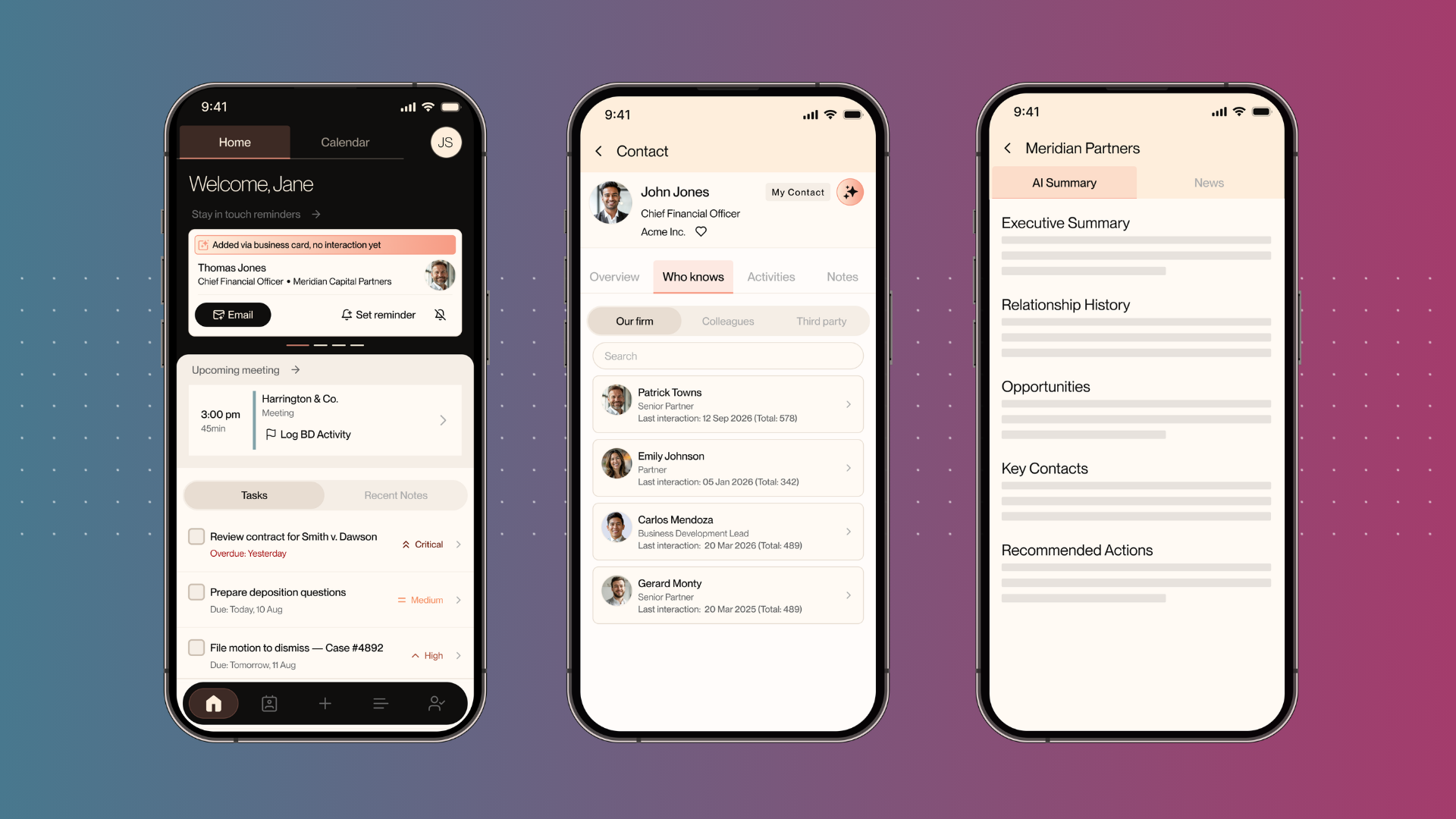
Explain how it works. Email integration automatically logs inbound and outbound messages involving a client contact, without collecting privileged information. Calendar integration surfaces relationship context before a meeting starts. The system works in the background without asking lawyers to open a form or complete extra fields.
Showing a partner how the Outlook add-in works is often the most effective move. They send an email to a client, and within minutes that message appears in the CRM with the relevant relationship context attached. That is usually the point where resistance starts to ease.
Addressing the confidentiality concern
Partners need confidence that sensitive information will be protected. Consider a legal CRM, rather than enterprise CRM, that is built with confidentiality in mind. Your CRM should capture client communications at the metadata level only: sender, recipient, timestamp, and subject line. The body of the email shouldn't be stored, and privileged communications should stay separate from the CRM.
Then explain the access controls. By default, a lawyer can only see the client relationships they own or have been granted access to. A partner in corporate won't have visibility into the client relationships of a partner in litigation unless access has been specifically configured that way. Access should be role-based and controlled by the firm. Back this up with documentation. Share your CRM security and compliance information with managing partners before the buy-in conversation begins.
Getting the pilot right
Pilots are one of your strongest persuasion tools because they move the conversation from theory to evidence. Here’s what you should consider before you get started:
- Choose two or three partners who are active in business development, relationship-focused, and influential with their peers. These are the people most likely to see value quickly and speak credibly about it to the wider partnership.
- Keep the timeline short. Sixty to ninety days is usually enough. Longer pilots tend to lose energy, while a tighter timeframe creates focus and gives you results quickly enough to report back before interest moves on.
- Define success before you start. That might be 500 net new contacts captured, 20 cross-sell opportunities surfaced, or a measurable increase in follow-up activity. Whatever you choose, make it specific and agreed upon upfront.
- Run the pilot against real work. Pilot users should be using the CRM in live client relationships and active BD efforts. Track progress closely, hold regular check-ins, and collect specific stories alongside the metrics.
At the end of the pilot, you should have data, examples, and internal advocates. That will make your the next conversation with the partnership considerably easier.
Running the buy-in meeting
This is the moment that matters. If you have 30 minutes with the managing partner, use it carefully:
- Start with a specific problem. Point to a situation that happened at your firm: a situation where two groups didn't realize they were already speaking with the same client, or a relationship that went quiet because no one was tracking it. Grounding the conversation in something real makes the issue easier to act on.
- Show the relationship data. Pull your contact database and create a simple view of what client relationships look like across the firm. Show who knows whom and where there are relationships that no one is actively maintaining. This is often the moment where partners realize they are operating with an incomplete picture.
- Explain the solution clearly. You are implementing a system that automatically logs client interactions and surfaces relationships across the firm, while keeping day-to-day lawyer behavior largely unchanged.
- Address the data entry concern before it comes up. Run a short demo showing how the system logs activity automatically from email and calendar. Removing that concern early clears the way for the rest of the conversation.
- Keep the ask narrow. Ask for a 60-day pilot with three partners and defined success metrics, framed as a limited and low-risk test. Close with the revenue model, keeping the figures specific to your firm.
Post-approval: the first 30 days
The first 30 days often determine whether the project gains real traction. Three tips to set yourself up for success:
- Plan your early wins before implementation begins. Decide which relationships should appear when partners first log in and which partners are most likely to spot quick expansion opportunities. Identifying those moments before launch day means you're ready to act on them immediately.
- Report back quickly. By day 15, you should have something worth sharing. A short update noting that the CRM captured 150 new contacts and surfaced seven potential cross-sell opportunities in the first two weeks builds confidence early and keeps the partnership engaged.
- Celebrate specific wins where others can see them. If a client expansion opportunity surfaces because the firm had better relationship visibility, share that story in a partner meeting. Concrete examples travel further than training materials.
Ready to transform your firm's growth?
%20(1).avif)
%20(1).png)
%20(1)%20(1).png)
.svg)

%20(1).avif)