
.svg)





.avif)

Client relationships have always mattered in legal work, but as AI tools reshape the practice of law, they're becoming an increasingly important competitive advantage for law firms. We invited Tanya Riggan, Vice President of Client Relations at Koley Jessen, to unpack the topic with Lynn Tellefsen Stehle, Head of Client Collaboration at Nexl.
AI is splitting legal work in two
McKinsey’s report on the impact of AI on law firms posits that AI is splitting legal work by judgment and relationship capital, with routine drafting, review, and research moving toward commodity pricing while strategic advice, regulatory relationship capital, and complex deal structuring are holding or growing their premium. Lynn pointed to Thomson Reuters' Future of Professionals research for the more hopeful reading of the same trend: as work gets cheaper, demand rises and clients will send more of it to the firms they trust.
Koley Jessen has been public about their adoption of Harvey, a legal AI platform now working with more than 1,000 customers across 60 countries, including half of the AmLaw 100. A study Harvey ran with RSGI found power users at law firms are saving close to 37 hours a month. For Lynn, that changes what a firm competes on, as efficiency becomes table stakes. Tanya sees the same shift as a long-awaited opportunity for the business development side of law firms.
"AI is really an opportunity for all of us to change the way that we think about things. Law firms are going to have to approach business development more like a traditional company in the way that they build relationships, and I think that's going to be the biggest change. Our assumption is that firms are going to need more work to fill the same amount of time, meaning pricing models will need to evolve as AI continues to reshape how we work."
Pricing pressure remains anticipatory
ACC and Everlaw’s 2025 survey found that nearly 60% of legal professionals have seen no noticeable savings from their outside counsel's use of generative AI, even as in-house adoption of the technology more than doubled. Anecdotally, many across the industry are expecting pricing pressure to come, but for now, Tanya has found this expectation to be anticipatory.
"Right now, clients are just asking about how we're using AI. We have a webinar and video series that showcases our AI usage because we're trying to be transparent with clients."
Despite this, Koley Jessen is preparing for future changes. "We know pricing needs to evolve, because it's not likely that the billable hour will make sense in the long term, so we're testing more project-based pricing. We’ve got to test and iterate to figure out how things are going to work. I'm not sure if anyone in the industry has quite solved the pricing problem just yet."
Relationships are where Tanya sees a lasting advantage for firms. "I do think that that's going to be the differentiator in the future. The riskier the decision, the more clients will want somebody else responsible for it."
How Koley Jessen designed a relationship-led growth strategy
At Koley Jessen, AI was a trigger for planning a new strategic approach to client relations. "Last fall when we were doing our strategic planning sessions, there was a lot of talk about AI. The firm had all these pillars associated with what we're going to on the practice side of things. We dug in pretty deep on what that means for the future, and it meant doubling down on business development."
"Our new initiatives were championed by an attorney on our executive committee who's really great at client relationships. He realizes that you can't scale that piece of the business if you don't take a different approach because there's only so many hours in the day. Sure, AI might free up some more time, but let's be real, AI is also creating more work by allowing you to do things you weren't doing before." The firm's response was to get more deliberate and borrow from how other businesses grow, taking a more sales-oriented approach with the goal of scaling relationship-building work. One partner shifted time away from practicing law and toward business development to get it moving. There are three initiatives they’ve started implementing as part of this strategy so far:
- A referral engine
- A concierge service
- AI tooling
Structured referral engine
The first initiative is a referral engine. The partner leading it focuses on referral relationships with accountants, investment bankers, private equity firms, and brokers, weighted toward the M&A side. The firm had long kept a database of these contacts, but it had never been used well because the right information was not being recorded.
"While our attorneys are always trying to be connectors, everybody's super busy and when an opportunity comes in, how can you be sure you’re connecting them with the best options? How can one attorney remember what all the investment bankers they've met over the course of their career do?"
A dedicated business development manager now orchestrates referrals behind-the-scenes, using a shared workspace and follow-up process that loops in attorneys who recently worked with a referral source. This process led Koley Jessen to replace regular firm-wide emails asking if anyone knows someone who works in a specific field.
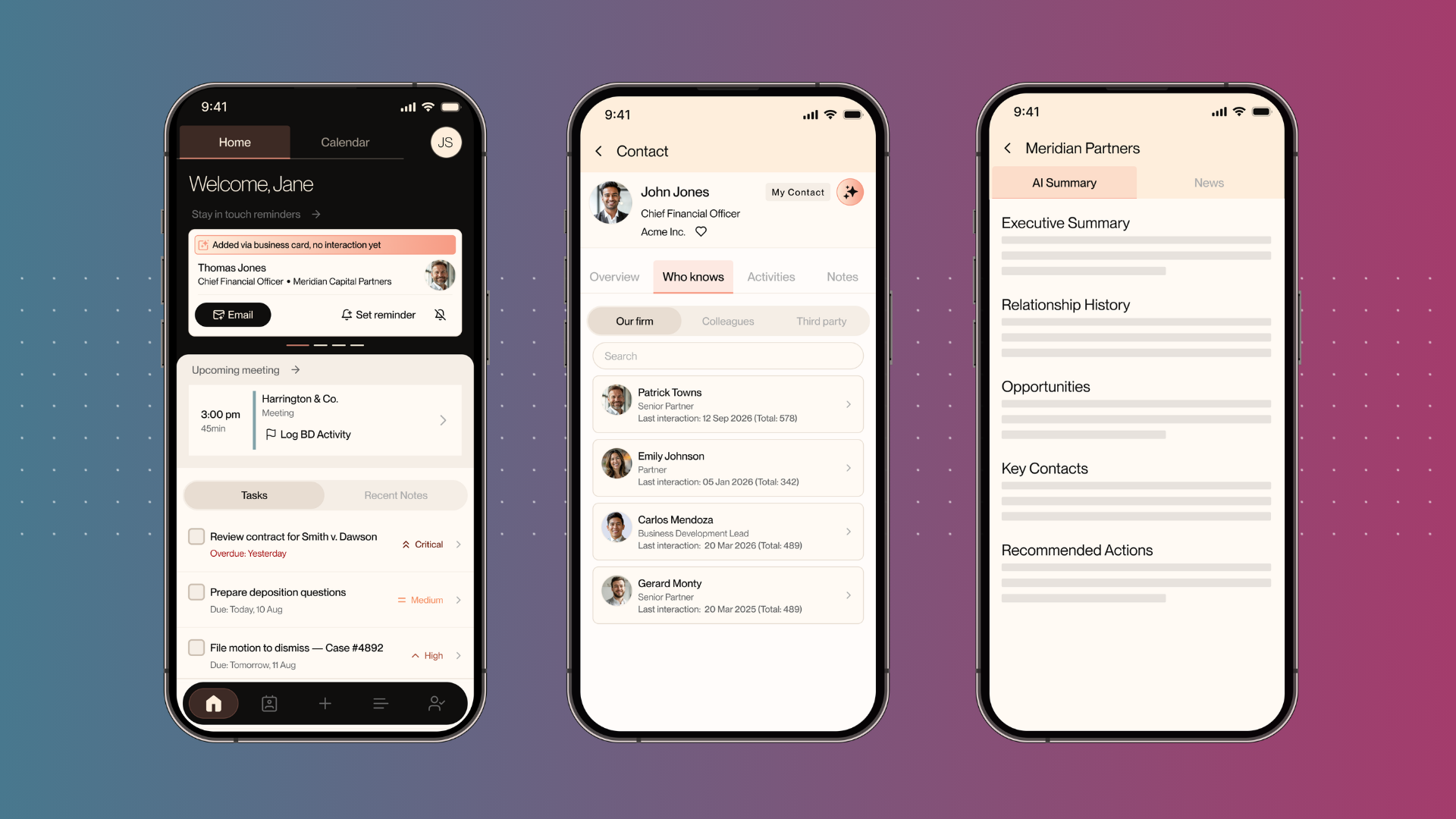
"It's allowed us to get the right information at the right time quickly. Nexl has been a game-changer for us because we could actually see who talks to a client, combined with financial information. We can make better decisions and involve the right people when something pops up because we can see all the relationship information."
Dedicated concierge service
Their concierge initiative aims to close the gap between intent and action for client relations. "What I really want to do is enable attorneys to support clients—it's sort of like coaching on steroids."
The distinction Tanya draws is between coaching and execution. Coaching alone leaves follow-up to attorneys, who rarely have time for it. So, their concierge team also takes on the first stage of execution work: assigning people to tasks, keeping a running list of action items, and preparing emails wherever they can. "It's so much easier for an attorney to open and edit a draft versus having to write something from scratch." The team saves drafts as ready-to-go files so attorneys have one less step to take.
The firm has chosen four attorneys for the program, spread across practice groups, and kicked off each group with a strategy session to define what they want to accomplish. The model is already working well with one of the firm's rainmakers, who has a marketing team member acting as an accountability partner. "[The partner] loves it. He can get so much more done because he's got stuff ready to go." Beyond the saved time, he has someone supporting him with context across what else is happening in the firm.
Personalized AI tooling
Koley Jessen's third initiative is using AI to build personalized tools for the firm. Tanya has created projects for recurring work using Claude, including one that produces tailored introductions for proposals. Her advice to anyone starting out is to use AI to help guide you on how to build your intended output and put time in up front to provide lots of content. "You have to invest the time and sometimes it's hard because we're all busy, but take a day and see what you can make."
The clearest example of how AI tools have changed the firm’s capability was when Tanya received a request for clients who might be candidates for an ESOP (employee stock ownership plan). Before AI, creating a list would have taken a week and the output wouldn't have been incredibly strong. "Now, I’m able to identify a subset of folks who were on a business succession mailing list, start with that, and then I had AI help analyze each of the companies and figure out if they might be a good candidate."
Client development versus business development
In Tanya’s view, "client development [is] everyone's job". Conversely, business development asks for something more deliberate. "Business development takes a lot more intentional effort—more planning, more time." Tanya’s approach is to give everyone a baseline set of tools and training for client development and then concentrate investment behind people who are wired for business development so they can go further.
Across every initiative, she keeps coming back to the human element. "I think that's where we all have to be careful with AI—legal work still needs human capital. I’d challenge everyone to experiment with AI and be OK with failure, because you're not going to get anywhere if you don't try. It's really important that firms invest in this, but I think that there's still a lot of room, even if you might not have those resources, to experiment."
Ready to transform your firm's growth?
%20(1).avif)
%20(1)%20(1).png)
.png)
.svg)

%20(1).avif)