
.svg)


.avif)


.avif)

For too long, law firms have celebrated revenue as the ultimate indicator of success. But as market pressures intensify, clients scrutinize bills, and operational costs balloon, forward-thinking firms are shifting their focus to a more telling metric: profitability.
This shift isn’t just about finance—it’s a strategic transformation that demands new roles for business development (BD) and marketing teams. It’s a call to move from top-line celebration to bottom-line optimization—and to help partners rethink how they measure client value.
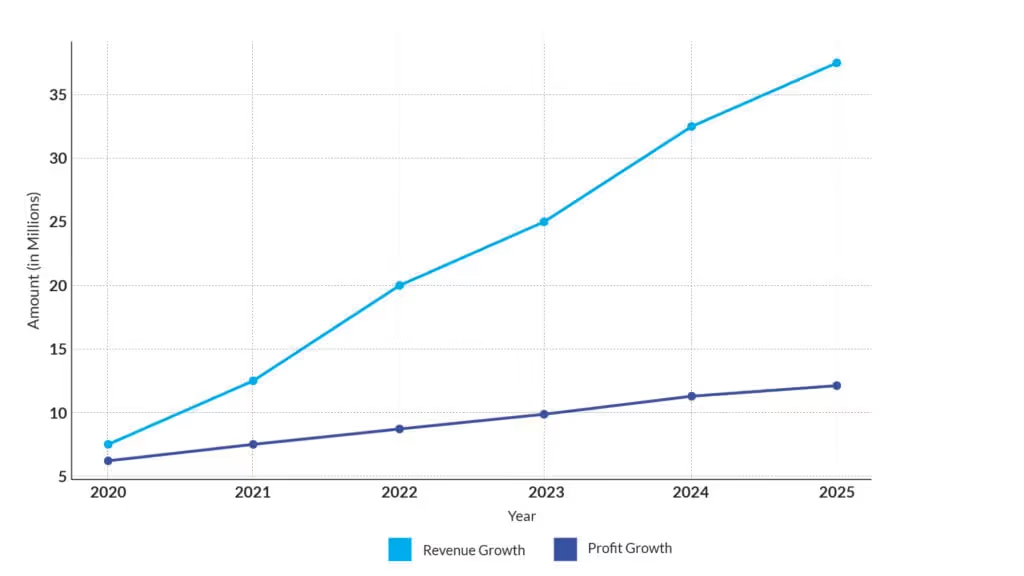
Exponential revenue growth, doesn’t always mean exponential profit growth.
EXAMPLE: Revenue Growth Vs. Profit Growth Chart
When a Million-Dollar Matter Isn’t Profitable
At a glance, a high-revenue client or matter might seem like a win. But dig deeper, and the story often changes. Hidden beneath the surface are untracked costs: steep write-offs, associate-over-partner imbalances, extensive non-billable time, client demands for in-person meetings (without paying for them), and pricey “value-adds” like CLEs or hotlines.
One firm addressed this by directly tying business development expenses to client files, adding costs like donations or travel to the invoice—even if they later write them off internally. Why? Because it gives both the firm and the client a real view of investment and profitability. In one instance, a client’s CLO was stunned: “I had no idea—that’s too much.”
That’s the point. Visibility drives accountability, both internally and externally.
Moving Beyond the Bill: Delivering Perceived Value
A $6 million invoice can feel either justified—or outrageous—depending on how the relationship was managed.
Law firms have a client experience problem. While the Big Four audit firms conduct extensive post-mortems (some logging 100 hours of interviews and delivering detailed strategic reports), many law firms go silent after a matter concludes. The result? Clients are left wondering, “Was it worth it?”
For marketing and BD leaders, this is an opportunity. What if your team owned the post-engagement experience? Imagine sending clients a tailored annual report capturing:
- Total “free” hours (secondments, CLEs, advisory)
- BD investments and sponsorships
- Strategic outcomes and key milestones
- Recommendations for improvement
These aren’t just value-adds—they’re relationship insurance policies. They deepen client loyalty and justify rate increases in a way that few sales pitches can.
Reshaping Work Models to Protect Margins
Profitability isn’t just about charging more—it’s about structuring work smarter. Low-margin engagements quietly erode the bottom line, yet partners often hesitate to walk away from guaranteed dollars, even when better opportunities exist.
That’s where BD and marketing leaders must bring data into the spotlight. At one roundtable, leaders shared how presenting a single stat—clients with four service lines spend 55% more than those with three—became a powerful tool to push partners toward cross-selling.
Innovative firms are going further, creating subsidiaries or dedicated structures to handle lower-value work efficiently. BCLP, for example, launched BCLP Cubed to reimagine delivery of commoditized services. One concept included an “Uber for associates,” routing matters to the right resources based on skill, availability, and cost—all backed by data.
Technology as the Profitability Engine
Tech alone won’t solve profitability challenges—but the right tools, paired with the right mindset, can transform how firms operate.
Large Language Models (LLMs) offer potential to automate note-taking, identify follow-ups, and surface sales intelligence. Imagine a partner dictating, “Let’s meet in two weeks,” and a CRM automatically logging that task and setting reminders for BD teams to follow through.
But tech is only as good as its inputs. One universal challenge is data quality—often undermined by quick-entry habits, inconsistent labeling, or lack of “marketing math” skills among BD professionals. Firms need hybrid talent: BD leaders who are also savvy data translators.
An 80/20 rule applies here: use what’s clean, flag what’s not, and train teams to navigate imperfect data with strategic clarity.
The New Mandate: BD as Profitability Stewards
Revenue is no longer the end goal—it’s a piece of a larger puzzle. The firms that thrive will be those who reframe BD and marketing as strategic operators, embedded in profitability discussions and empowered with data, tools, and trust.
This means:
- Tracking true cost-to-serve for top clients
- Building client value reports to justify rates and deepen relationships
- Rethinking low-margin work through innovation and segmentation
- Elevating BD from support function to strategic command center
It’s time for law firms to trade vanity metrics for value. And for BD and marketing leaders to lead the charge.
WATCH WEBINAR – From Insights to Impact: Executing Strategic Plans
Ready to transform your firm's growth?
%20(1).avif)
Leadership & insights
Related posts

Rethinking Rainmakers: How Law Firms Can Drive 42% Better Growth Without Heroics
Designed for partners, senior associates, BD leaders, and firm leadership, this session delivers a clear diagnosis of your current BD model and 3–5 concrete actions you can implement in the next 90 days to drive sustainable, scalable growth.
Value Case Builder Checklist: Turn Great Ideas Into Firm Backed Initiatives
Law firms move quickly, but approvals do not. Great BD and marketing ideas can stall because they are not packaged in a way that speaks the language of partners. To help teams build stronger business and value cases, we have created a practical checklist grounded in two proven frameworks. It brings together the CARD method

.svg)

%20(1).avif)